

The short answer
Warm air from a running AC usually comes from the outdoor unit not doing its job (a failed capacitor, contactor or fan), a refrigerant leak, a very dirty coil or a thermostat problem. Check the settings and the outdoor fan; if those look right, switch it off and have it tested.
There is a difference between an AC that cannot keep up on a hot afternoon and one that blows air that is barely cooler than the room. The second one is a fault, and it usually lives in one of four places.
This guide walks through those four places, what you can see from the outside, and why a refrigerant leak needs to be found before anything else is done.
Step 1: Feel the air at a supply vent
Hold your hand at a vent near the indoor unit. With the system cooling, that air is normally clearly cool. If it feels like room air, the refrigeration side is not working; if it is cool but weak, the problem is more likely airflow.
That one observation splits the problem in two, and it is worth mentioning when you call.
Step 2: Rule out the thermostat
A thermostat set to Fan On blows room air between cooling cycles, and one with weak batteries or a loose wire may never call for cooling. Confirm the mode is Cool, the fan is Auto and the set point is below room temperature.
Step 3: Watch the outdoor unit
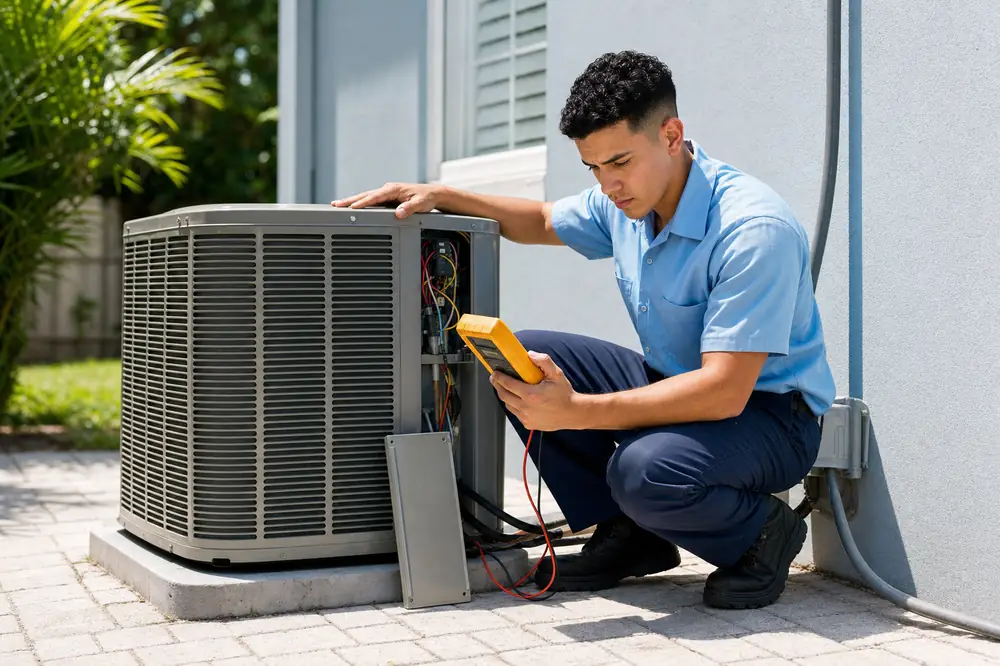
The outdoor unit is where the heat from your house is released. If its fan is not spinning, or the compressor is not running, the air inside cannot be cooled.
- Fan still while the unit hums: a weak capacitor or a failed fan motor
- Unit completely silent: power, the contactor or the thermostat signal
- Fan spinning but the large copper line feels warm: a compressor or refrigerant issue
Don't: open the electrical panel on the outdoor unit. The capacitor holds a charge even with the power off.
Step 4: Look for signs of a refrigerant leak
A system does not consume refrigerant. If the charge is low, it is escaping somewhere: a coil, a fitting or the line set. Signs include ice on the lines, an oily stain at a joint, a hissing sound, and cooling that slowly got worse over weeks.
Adding refrigerant without finding the leak gives a few good weeks and then the same problem. Refrigerant leak repair means locating the leak, repairing it, pressure testing, and then charging to the right level.
Step 5: Consider the coils
An outdoor coil packed with dirt cannot release heat, and an indoor coil coated with dust cannot absorb it. Both make the air warmer. Rinsing the outdoor coil gently with a garden hose, from the inside out if possible, is safe; the indoor coil is a job for us.
Dirty coils are one of the main things a tune-up addresses.
Step 6: Switch it off and have it tested
A system blowing warm air keeps running because the thermostat is never satisfied, and that means hours of wear on the compressor. Once the settings and the outdoor unit are checked, switch it off.
On an AC repair visit we test the capacitor and contactor, measure the refrigerant pressures and temperatures, and check the coils, so the fix matches the cause.
What the fix usually looks like
Most warm-air repairs fall into a few groups, and each one has its own sequence of work. The test results decide which group you are in, not a guess based on the age of the system.
- Electrical part at the outdoor unit: replace it and test the system under load
- Refrigerant leak: find it, repair it, pressure test, evacuate and charge to the right level
- Dirty coil: clean it, then recheck pressures and airflow
- Thermostat or wiring: trace the signal from the thermostat to both units
When the compressor itself has failed, the conversation becomes repair versus replacement. Our repair or replace checklist helps frame that decision before you hear any recommendation.
What to tell us when you call
- Whether the air is warm or just weak
- Whether the outdoor fan spins and the compressor hums
- Any ice, hissing or oily stains on the lines
- Whether cooling stopped suddenly or faded over weeks
- The age of the system, if you know it
How to avoid it next time
Capacitors weaken with heat and age, coils collect dirt, and small leaks grow. A yearly check of the electrical parts, the coils and the refrigerant pressures catches most of this before a hot day exposes it.
- Keep the outdoor coil clear of grass clippings and leaves
- Change filters on schedule so the indoor coil stays clean
- Have a slow decline in cooling checked early instead of waiting for a full stop
Key takeaways
- Warm air and weak air are two different problems — note which one you have.
- A still outdoor fan with a humming unit often means a capacitor or fan motor.
- Low refrigerant means a leak; find it before recharging.
- Switch a warm-air system off to protect the compressor.
Further reading
- Maintenance Checklist ENERGY STAR
Questions
Why did my AC start blowing warm air right after a storm?
A power surge or flicker can damage a capacitor or contactor, and debris can block the outdoor fan. Check the breaker and the disconnect, look at the fan, and if it does not run, have the electrical parts tested.
The air was cool this morning and warm this afternoon. What changed?
A part that is failing can work while it is cool and quit when it heats up, a capacitor being the classic example. Another cause is ice building on the indoor coil during the day, which blocks airflow.
Is warm air from the vents always a refrigerant problem?
No. Electrical parts at the outdoor unit and dirty coils cause the same symptom. Testing is the only way to know which one it is.
Can I keep running it until the weekend?
It is better not to. A system that cannot cool runs continuously and stresses the compressor. Switch it off and use fans until it is checked.