

The short answer
Start with the thermostat setting, the breaker, the filter and the outdoor unit. If the system still runs without cooling after those checks, switch it off and let us test the electrical parts, the coil and the refrigerant side. Guessing at parts is how good parts get replaced.
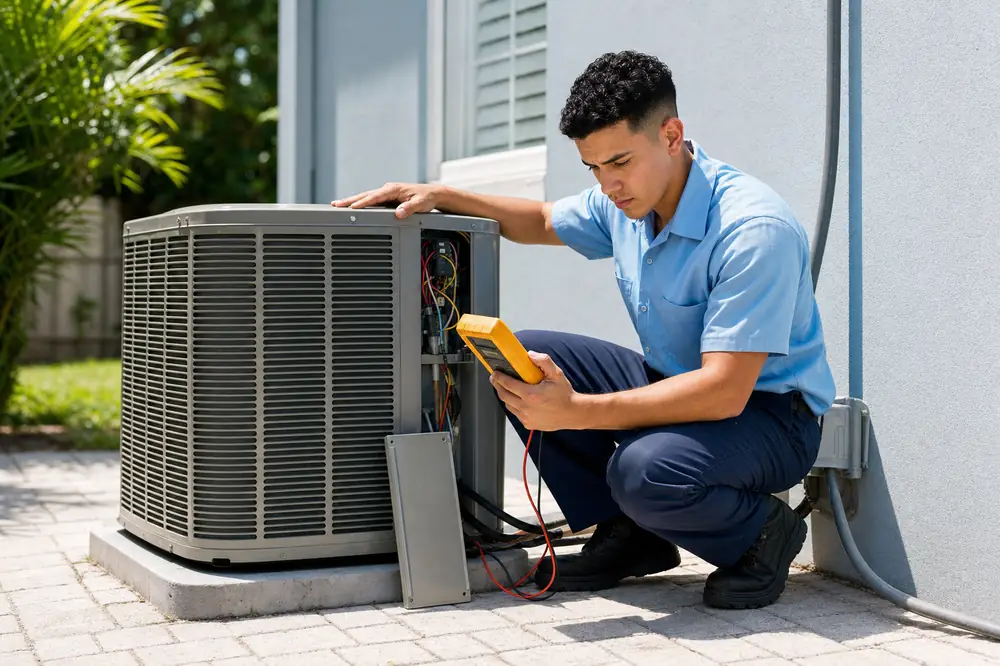
An AC that runs but does not cool is the most common problem a South Florida system has, and it has a short list of causes. Some of them you can rule out yourself in a few steps, without tools and without opening any panel.
Go through the checks below in order. Each one either fixes the problem or tells you something useful to pass on when you talk to us. If you reach the end and the house is still warm, that is the moment to stop and have the system tested.
Step 1: Check the thermostat
Make sure it is set to Cool, not Heat or Fan, and that the set temperature is a few degrees below the room temperature. If the screen is blank, replace the batteries if it uses them.
- Mode: Cool
- Fan: Auto (On runs the fan nonstop, even when the system is not cooling)
- Set point below the current room temperature
- No schedule or "hold" overriding your setting
Step 2: Look at the breaker and the outdoor switch
In the electrical panel, the AC usually has its own double breaker. If it has tripped, it sits in the middle position. Reset it once by pushing it fully off and then on.
Don't: reset a breaker that trips again right away. A breaker that keeps tripping is protecting something — a failing motor, a shorted wire, a stuck compressor — and needs a test, not another reset.
Next to the outdoor unit there is a disconnect box. Someone working in the yard can switch it off by accident, so check that it is on.
Step 3: Pull the filter
A clogged filter starves the indoor coil of air. Cooling drops, the coil can freeze, and the blower works harder. Hold the filter up to a light: if you cannot see through it, replace it.
In South Florida a standard 1-inch filter often needs changing every month or two during the long cooling season, sooner with pets or construction dust in the house.
Step 4: Walk the vents and returns
Closed supply registers and blocked return grilles change how air moves through the whole system. Open every register and move furniture, rugs and boxes away from the returns.
If air barely comes out of the vents while the indoor blower is running, the problem may be airflow: a dirty coil, a weak blower, or a duct that came loose. That points toward duct work or the indoor unit rather than the outdoor side.
Step 5: Look at the outdoor unit
With the system calling for cooling, the outdoor fan should spin and you should hear the compressor hum. Look for these signs:
- Fan not spinning while the unit hums: often a failed capacitor or fan motor
- Nothing running at all: power, the contactor or the thermostat signal
- Coil fins packed with grass clippings, leaves or dirt
- Shrubs or a fence within about two feet of the cabinet
Don't: poke the fan blades with a stick to start them. If the fan does not start by itself, the part that starts it needs testing.
Step 6: Check for water and ice
Look at the large copper line at the outdoor unit and at the indoor unit. Ice on the line or the coil means the system is starved of airflow or low on refrigerant. Water around the indoor unit usually means the drain line is clogged.
If you find ice, switch the system to Off and the fan to On so it can thaw. Our guide on ice on the AC lines explains why, and the one on water inside covers the drain.
Step 7: Know when to stop
If all of the above is fine and the air from the vents is still warm, the cause is inside the system: a capacitor, contactor, refrigerant leak, a dirty coil or a compressor problem. These need meters and gauges to tell apart.
Switch the system off rather than letting it run for days without cooling. A system that runs and cannot cool keeps adding wear to the compressor, the most expensive part in it. Our AC repair visits start with exactly these tests.
What to tell us when you call
- What the system is doing: running and not cooling, not starting, short cycling
- What you already checked from this list, and what you found
- Whether the outdoor fan spins and whether you hear the compressor
- Any ice, water or tripped breaker
- Roughly how old the system is and where the indoor unit sits
How to avoid it next time
No-cooling problems usually trace back to parts that wear slowly: a capacitor losing strength, a coil collecting dirt, a drain line growing algae. A tune-up once a year, ideally before the hottest months, catches those while they are still small.
- Change the filter on a schedule, not when you remember
- Keep two feet of clear space around the outdoor unit
- Pour a cup of white vinegar down the drain line access every few months if your system has one
- Book a maintenance visit before summer
Key takeaways
- Thermostat, breaker, filter and vents are safe for you to check.
- A breaker that trips twice needs a test, not a third reset.
- Ice means airflow or refrigerant; switch to Off with the fan On.
- Warm air after all seven checks means a part inside the system — stop running it and have it tested.
Further reading
- Maintenance Checklist ENERGY STAR
Questions
My AC runs all day but the house stays at 80 degrees. Is that normal in a heat wave?
On the hottest afternoons a correctly sized system can run long and fall a few degrees behind, then catch up in the evening. If it never catches up, or the air from the vents feels barely cool, something is limiting it: airflow, a dirty coil or a refrigerant problem.
The outdoor unit hums but the fan does not turn. What does that mean?
Often a failed run capacitor or a fan motor that has seized. Switch the system off at the thermostat so the compressor does not keep trying to start, and have the capacitor and motor tested.
Can a dirty filter really stop my AC from cooling?
Yes. With too little air crossing the indoor coil, the coil gets too cold, can freeze into a block of ice and stop cooling almost completely. A new filter is the first thing to rule out.
Should I add refrigerant myself?
No. A system does not use up refrigerant; if it is low, there is a leak. Adding more without finding the leak only delays the problem. See refrigerant leak repair.