

The short answer
On cold mornings a heat pump may run longer, release steam from the outdoor unit during defrost, and bring on heat strips for extra warmth. That is normal. Ice that stays on the outdoor unit, air that never warms, or heat strips running all the time are worth checking.
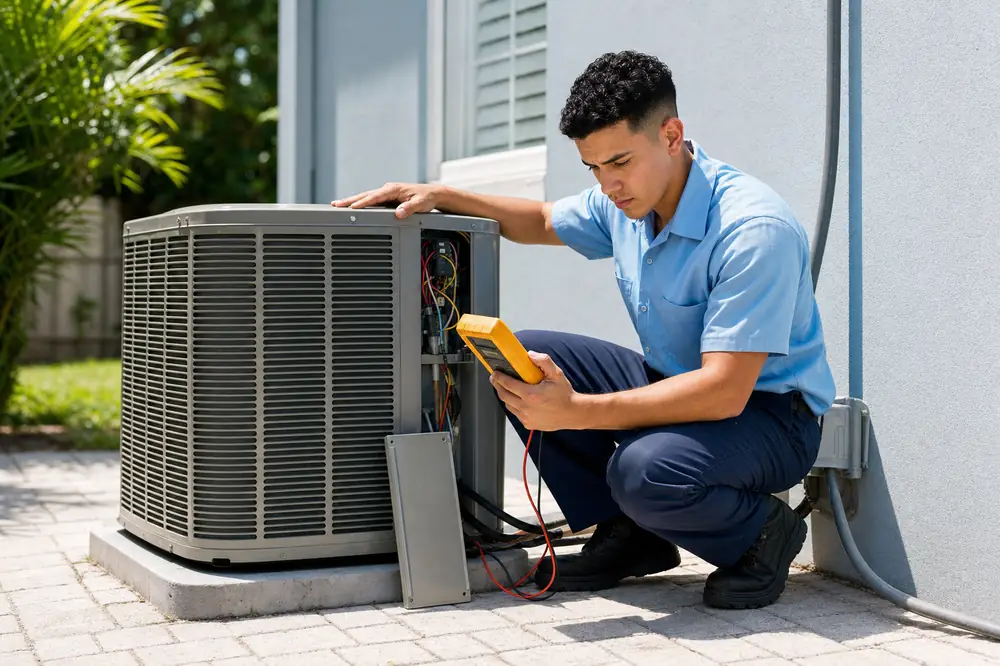
Most South Florida homes heat with a heat pump: the same system that cools in summer runs in reverse to move heat indoors. It is efficient, but it behaves differently from a furnace, and the first cold front of the year often brings questions.
This guide explains what is normal for a heat pump on a chilly morning and what is not.
Step 1: Expect longer run times
A heat pump delivers steady, moderate warmth rather than a blast of hot air. On a cold morning it may run much longer than usual. That alone is not a fault.
Hold your hand at a vent near the indoor unit: in heat mode the air should feel clearly warmer than the room, even if it is not hot.
Step 2: Recognize a defrost cycle
In cool, damp weather, frost can form on the outdoor coil. The system briefly reverses to melt it. During defrost the outdoor fan may stop, you may hear a whoosh, and steam can rise from the unit. The indoor air may feel cooler for a short time.
Steam during defrost is water vapor from the melting frost, not a problem.
Step 3: Understand heat strips
Many systems have electric heat strips in the indoor unit for extra warmth when the heat pump alone cannot keep up, or during defrost. On the thermostat this may show as auxiliary or emergency heat.
Emergency heat runs only the strips and skips the heat pump. Use it only if the heat pump has failed; it is much less efficient.
Step 4: Know the warning signs
- Thick ice that stays on the outdoor unit after defrost
- Air from the vents that never feels warm
- Heat strips running constantly in mild weather
- The outdoor fan or compressor not running at all in heat mode
- A breaker that trips when the heat comes on
Any of these is worth a heating repair visit.
Step 5: Check before the cold arrives
The reversing valve, defrost controls and heat strips only get used a few weeks a year, which is when a weak part shows up. A quick heating maintenance check in the fall tests them before you need them.
Don't: cover the outdoor unit or block it with plants to protect it from the cold. It needs open airflow to work in heat mode too.
Step 6: Use the thermostat well in winter
Large setbacks work against a heat pump. If you turn the heat far down at night and back up in the morning, the system often brings on the heat strips to recover, and they use much more electricity. A steady setting, or a small setback, keeps the heat pump doing most of the work.
Smart thermostats made for heat pumps can recover gradually; see our thermostat guide for settings that suit Florida.
Step 7: Know the sounds
- A whoosh when defrost starts or ends: the reversing valve shifting
- The outdoor fan stopping for a short while: normal during defrost
- A steady hum with the fan still: worth a check
- Grinding or screeching: switch the system off
Normal sounds come and go with defrost. Sounds that are new, constant or harsh are worth a heating repair visit before the next cold morning.
Why the strips should rarely run
South Florida winters are mild. On most cool days, a heat pump that works correctly handles heating on its own, and the strips only help on the coldest mornings or during defrost.
If the strips seem to run every time the heat comes on, or the electric bill jumps after one cool week, the heat pump may not be doing its share. That is worth testing, not just living with.
What to tell us when you call
- What the outdoor unit is doing: frost, ice, steam, fan stopped
- Whether the air from the vents feels warm, cool or room temperature
- What the thermostat shows (heat, auxiliary, emergency)
- Whether a breaker tripped
- The age of the system
How to avoid it next time
A heat pump that cools well all summer usually heats well too, as long as its winter-only parts are checked.
- Have heating mode tested in the fall
- Keep the outdoor unit clear of leaves and plants
- Use emergency heat only when the heat pump has failed
- Change the filter before the cool season
Key takeaways
- Long run times and steam during defrost are normal.
- Heat strips add warmth; emergency heat uses only the strips.
- Lasting ice, cool air or strips running nonstop are warning signs.
- Test heating mode before the first cold front.
Further reading
- Air-Source Heat Pumps ENERGY STAR
Questions
Why is steam coming from my outdoor unit?
It is almost certainly a defrost cycle melting frost on the coil. The steam stops when defrost ends.
Should I switch to emergency heat when it gets cold?
Only if the heat pump has failed. Emergency heat skips the heat pump and uses only the electric strips, which is far less efficient.
Why does the air feel lukewarm in heat mode?
Heat pump air is warm, not hot, compared with a furnace. If it feels like room air, though, the system may not be heating and should be checked.
Can my AC system heat if I do not have a heat pump?
Some systems cool only and heat with strips. We can tell which you have and what heating installation options fit.